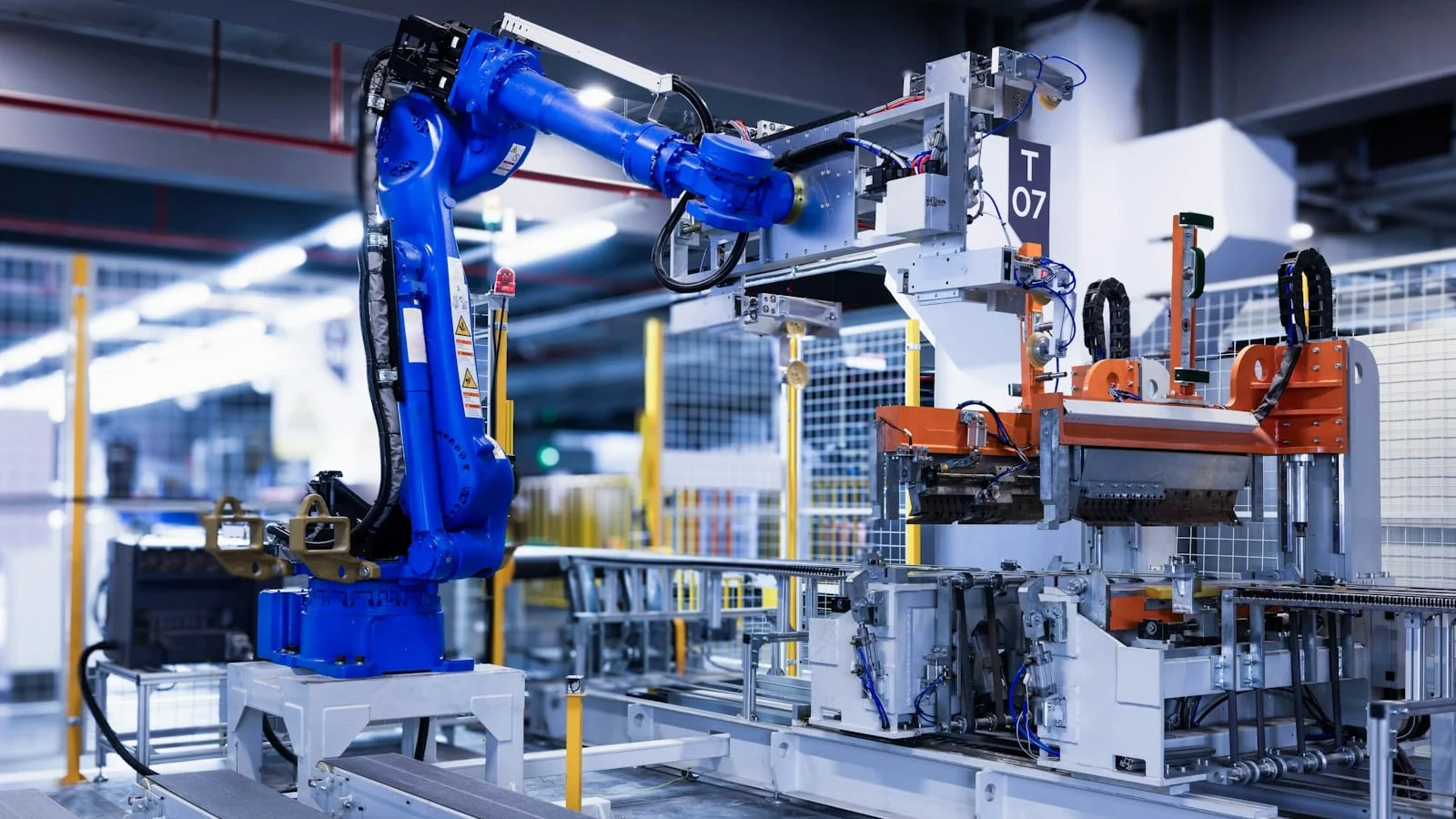
A camera above a production line photographs each part as it passes. A model decides whether the part is good. If it is not, an actuator further down the line must push it aside before it reaches packing. The time available for that decision is set by the speed of the line and the distance to the actuator, and on a fast line it is measured in milliseconds.
That constraint, more than any fashion in architecture, explains why manufacturers are running AI on the factory floor rather than in a distant cloud region. The same logic applies to machine control, where a model adjusts equipment settings in response to sensor readings and a late answer is a wrong answer.
Why the cloud is too far away
A round trip to a cloud region adds delay, and the delay varies. For dashboards that hardly matters. For a reject decision with a fixed deadline, the worst case matters more than the average, and the worst case over a wide-area network is hard to bound. Many plants also sit in industrial zones or regional towns where connectivity is less dependable than at head office, and a line cannot stop because a link has dropped.
For a reject decision with a fixed deadline, the worst case matters more than the average.
The CIO Table
Bandwidth is the second problem. Inspection cameras produce high-resolution images continuously, often from several angles at each station. Streaming all of it to the cloud costs money in uplink capacity and data charges, and most of those images show nothing of interest. Paying to send a photograph of a good part across a network so that a remote server can confirm it is good is poor economics.
In Asia-Pacific the shape of the industry sharpens these pressures. Manufacturers often run plants in several countries, newer facilities alongside older ones, under different telecoms conditions and, in some markets, rules or customer contracts that limit where production data may go.
A split architecture
The emerging pattern divides the work. Inference runs on the line, on an industrial computer or small server with an accelerator, close to the cameras and controllers. Training, labelling, model management and long-term storage stay in the cloud or a central data centre, where compute is elastic and data from many lines can be pooled.
Traffic between the two is selective. The edge sends back rejected images, a sample of passes, borderline cases and summary data. The centre sends down new model versions through a controlled release, with version records and the ability to roll back. If the link fails, the line keeps running on the last approved model and queues its uploads until the connection returns.
Who owns a server bolted to a line
The harder problem is ownership, because an edge device belongs to two worlds. Operational technology teams own uptime, safety and the change windows on the line. IT teams own patching, identity, monitoring and security standards. A server on a production line is both, and unless ownership is settled explicitly, it falls to whoever is on shift when the device fails.
A workable division gives IT the standards and the remote management, and gives OT authority over when changes happen. Each device needs a named owner and an entry in the asset register. Four practices follow:
- Patch without stopping the line by pairing devices, so one can be updated while the other carries the load, or by scheduling updates into planned maintenance windows.
- Test updates on a reference line or replica rig before release, then roll out to one line, then one plant, then the rest.
- Keep pre-imaged spares at each plant, specified for heat, dust and vibration, because lead times for accelerator hardware can be long.
- Define a standard kit per line: the same hardware, operating system image, camera interfaces and management agent everywhere. Variation between plants is what makes support across countries expensive.
Security on the plant network
An edge device is a bridge between the plant network and the outside world, which makes it a target. Plant networks often carry older control systems that cannot easily be patched, so the edge box must not become the way in. Place devices in their own network zone, in line with the zones-and-conduits approach of the IEC 62443 standards. Allow only outbound connections to approved endpoints, give each device its own certificate-based identity, accept only signed software and signed models, and route remote access through a single controlled point with session logging.
What to measure
Accuracy figures from a supplier’s test set say little about performance on a particular line. Measure what the plant already cares about, against a baseline taken before go-live:
- Rework and scrap, to show whether defects are being caught earlier.
- False rejects: good parts discarded. They cost material directly and erode trust, and operators who stop trusting a system find ways around it.
- Escapes: defects that pass inspection and reach the next process or the customer.
- Unplanned downtime attributable to the system, including the edge hardware.
- Drift: changes in performance as lighting, materials or suppliers change.
- The time it takes to deploy a model update across every line.
Before approving the second line, ask for the false reject rate of the first, measured by the quality team rather than the supplier.